
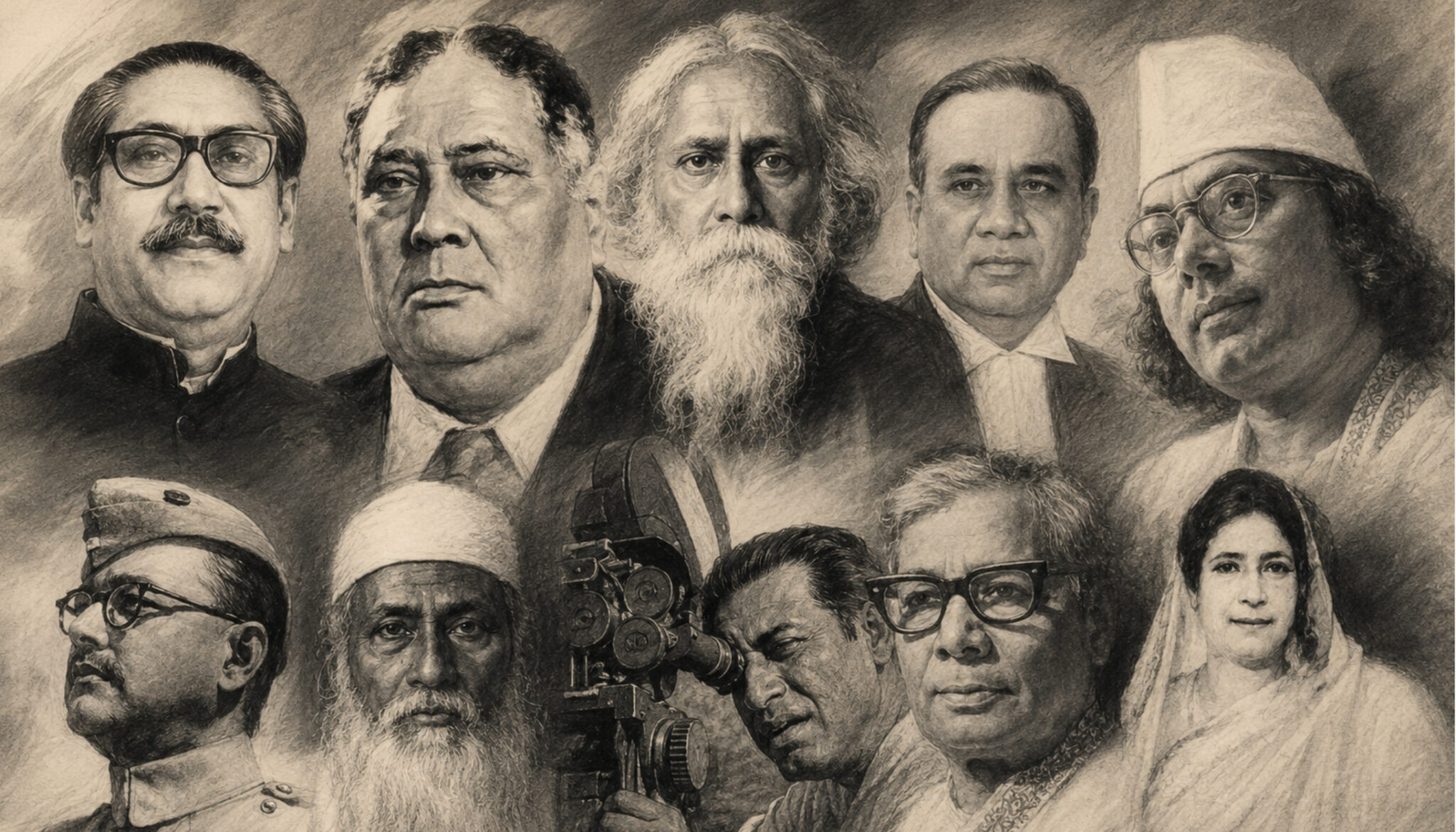

Some lists are just lists. This one is closer to a prayer.
In 2004, the BBC’s Bengali Service did something almost nobody had attempted before. It asked an entire linguistic nation, spread across Bangladesh, the Indian states of West Bengal, Tripura, Odisha, and Assam, and Bengali communities scattered across the globe, a single enormous question. Out of a thousand years of history, who deserved to be called the greatest Bengali who ever lived. Voters were asked to name five choices each, in order of preference, a method borrowed from the BBC’s earlier Greatest Britons poll to keep the results fair. Nearly two hundred fifty million people share this language, and from among all of them, past and present, 140 names were nominated before the field was narrowed down to a final twenty.
What came back was not a simple ranking of power or fame. It read more like a family album, assembled by millions of hands, each person reaching for the figures who had shaped how they see themselves. Two decades later, that list is still worth sitting with, name by name, not to argue over the order, but to properly remember why each of these twenty people earned their place in it.
1. Bangabandhu Sheikh Mujibur Rahman
At the very top, by a margin so wide it left almost no room for debate, stands the man Bengalis call Bangabandhu, Friend of Bengal. Sheikh Mujibur Rahman rose from student activism during the final years of British colonial rule to become the central figure in the movement for Bengali autonomy within Pakistan, championing Bengali identity and rights through the 1950s and 1960s despite repeated imprisonment. His Awami League swept Pakistan’s first democratic election in 1970, only for the military junta to refuse to hand over power, a betrayal that helped ignite the Liberation War of 1971. His speech of 7 March that year, now recognized on UNESCO’s Memory of the World register, is still remembered as one of the defining oratorical moments of the twentieth century. He became the founding leader of independent Bangladesh, and although his life ended in assassination in 1975, the nation he helped bring into being repaid him with the single largest vote of confidence any Bengali has ever received, nearly double the points of the second place finisher.
2. Rabindranath Tagore
Second place belongs to a man many simply call Kobiguru, the poet’s teacher. Rabindranath Tagore became, in 1913, the first Asian ever awarded the Nobel Prize in literature, honored for his collection Gitanjali. He was a genuine polymath, moving effortlessly between poetry, fiction, music composition, painting, philosophy, and education, and he personally founded the experimental university Visva Bharati at Santiniketan. He wrote the national anthems of two separate countries, India and Bangladesh, an achievement without real parallel anywhere else in the world, and his songs, known collectively as Rabindra Sangeet, remain a living genre performed daily across Bengal. To call him the Bengali Shakespeare, as many do, almost understates how completely he shaped the emotional vocabulary an entire people use to describe love, loss, nature, and hope.
3. Kazi Nazrul Islam
Where Tagore offered serenity, Kazi Nazrul Islam offered fire. Born in 1899, Nazrul served briefly in the British Indian Army before turning to poetry and journalism, and he was jailed by colonial authorities for the openly rebellious tone of works like his poem Bidrohi, or The Rebel. He edited newspapers that colonial censors repeatedly shut down, and yet the same defiant pen also produced hundreds of tender love songs and devotional hymns, spanning both Hindu and Muslim spiritual traditions, that are still sung in homes and shrines across Bengal today. He is now honored as Bangladesh’s national poet. His willingness to be both revolutionary and romantic, sometimes in the very same poem, is exactly why third place feels less like a ranking and more like a tribute to defiance itself.
4. A.K. Fazlul Huq
Known to history as Sher-e-Bangla, the Tiger of Bengal, A.K. Fazlul Huq built a long career as a lawyer, legislator, and champion of the region’s peasantry, eventually serving as Prime Minister of undivided Bengal. He is remembered above all for presenting the Lahore Resolution of 1940, the political declaration widely seen as the founding blueprint for the eventual creation of Pakistan, a document that reshaped the entire map of South Asia. Despite his central role in that moment, his career remained defined by an enduring focus on the welfare of Bengal’s farmers and rural poor.
5. Subhas Chandra Bose
Few names carry the electric charge of Subhas Chandra Bose. A former president of the Indian National Congress, he broke from Mahatma Gandhi’s strategy of nonviolent resistance and instead organized the Indian National Army, seeking military support from Axis powers during the Second World War to fight British colonial rule directly. Popularly known as Netaji, or respected leader, his disappearance and disputed death in 1945 only deepened the near mythic status he holds across Bengal and beyond. Bengalis remember him as living proof that the fight for freedom was never a purely political matter, but a deeply personal act of sacrifice.
6. Begum Rokeya Sakhawat Hossain
The only woman to reach the top twenty, Begum Rokeya earned her place through sheer intellectual courage. Writing in both Bengali and English in the early twentieth century, she challenged the restrictions of purdah placed on Muslim women of her era and founded one of the first schools for Muslim girls in Kolkata, an institution that still operates today. In her science fiction story Sultana’s Dream, she imagined an entire world reversed, where women led society and men lived in seclusion, a radical thought experiment for its time. Her presence on this list is a quiet but powerful reminder of how much of Bengal’s progress was built by voices that had to fight simply to be heard at all.
7. Jagadish Chandra Bose
Long before Bengal was known for poetry and politics on the world stage, Jagadish Chandra Bose was proving it could produce world class science too. His pioneering experiments with microwave and radio wave transmission in the 1890s predated Marconi’s famous demonstrations, though patent politics of the era meant Bose received far less credit at the time. He later invented the crescograph, a device sensitive enough to measure and record the growth responses of plants, providing striking evidence that plant tissue reacted to stimuli in ways strikingly similar to animal nerve tissue. His insistence on studying the boundary between living and non living matter reflected a distinctly Bengali blend of scientific rigor and philosophical curiosity, and he founded the Bose Institute in Kolkata to carry that spirit forward.
8. Ishwar Chandra Vidyasagar
Few individuals changed daily life for as many people as Ishwar Chandra Vidyasagar. His relentless campaigning helped secure the Hindu Widows’ Remarriage Act of 1856, directly confronting a practice that had condemned countless young widows to lifelong social exile. As an educator, he restructured how Sanskrit and Bengali were taught, and as a writer, he helped modernize and standardize Bengali prose itself, producing textbooks that shaped how generations of Bengali children first learned to read. His surname, meaning ocean of knowledge, was an honorific earned through his scholarship, not inherited at birth.
9. Maulana Abdul Hamid Khan Bhashani
Known affectionately as the Red Maulana for his blend of religious authority and left leaning politics, Bhashani spent decades organizing the peasants and laborers of Bengal and Assam against exploitative landlords and, later, against the economic domination of East Pakistan by the western wing of the country. He helped found the political party that would eventually become the Awami League, giving him a direct hand in shaping the movement that ultimately produced Bangladesh, even as he later split from its leadership over ideological differences. His willingness to challenge power on behalf of the powerless earned him a lasting place in the hearts of those he spent his life defending.
10. Raja Ram Mohan Roy
Often called the Father of the Bengal Renaissance, Raja Ram Mohan Roy helped launch the sweeping era of social and religious reform that reshaped nineteenth century Bengal. Fluent in numerous languages including Sanskrit, Persian, Arabic, and English, he founded the Brahmo Samaj, a reformist religious movement, and campaigned tirelessly against the practice of sati, the immolation of widows, contributing directly to its legal abolition in 1829. His advocacy for modern, English medium education helped set in motion generations of reformers who followed in his footsteps, several of whom appear elsewhere on this very list.
11. Titumir
Remembered as a fearless rebel leader, Syed Mir Nisar Ali, known to history simply as Titumir, organized a large armed uprising of Bengali Muslim peasants against oppressive zamindars and British colonial authority in 1831. His followers, numbering into the thousands, built a genuinely formidable bamboo fortress at Narikelbaria near Barasat, a structure so resilient it withstood sustained cannon fire from British artillery for hours before finally falling. Titumir was killed in the fort’s final assault on 19 November 1831, and his lieutenant Ghulam Masum was executed afterward, but the story of ordinary peasants building a fortress out of bamboo and holding off a modern army became one of the most enduring symbols of resistance in Bengali folk memory, still taught, staged, and celebrated across Bangladesh today.
12. Lalon Shah
A mystic, poet, and spiritual philosopher of uncertain birth and origin, Lalon Shah composed thousands of songs that dissolved the boundaries between Hindu, Muslim, and folk spiritual traditions long before pluralism became a modern ideal. Based for most of his life in Kushtia in what is now western Bangladesh, he led the Baul tradition of wandering minstrel philosophers, teaching a deeply humanist spirituality centered on the search for the divine within the self rather than through religious ritual or dogma. His folk philosophy still shapes Bengali spiritual and cultural life, sung by working musicians in villages across the delta to this day.
13. Satyajit Ray
Cinema found its Bengali master in Satyajit Ray, the director behind Pather Panchali, the debut film that instantly announced Indian cinema on the world stage in 1955, and later works including The Chess Players and the Apu Trilogy that followed. Working as an illustrator, advertising artist, and film critic before ever picking up a camera, Ray brought an extraordinary eye for human detail and a patient, unhurried storytelling style that earned him international acclaim across more than thirty films. In 1992, shortly before his death, he received an honorary Academy Award for lifetime achievement, accepted from a hospital bed in Kolkata, a fitting final tribute to a filmmaker who spent his life capturing the textures of Bengali life with genuine artistry.
14. Amartya Sen
The only living person to make the top twenty at the time of the poll, economist Amartya Sen was awarded the Nobel Memorial Prize in Economic Sciences in 1998 for his groundbreaking work connecting economics with ethics, welfare, and human capability. His research on famine, most notably his analysis showing that famines are rarely caused by an actual shortage of food but by failures of distribution and democratic accountability, reshaped how economists and policymakers around the world think about poverty and hunger. His presence on the list reflects a people who see intellectual achievement as every bit as worthy of celebration as political or artistic legacy.
15. The Language Movement Martyrs
Rather than a single name, this entry honors a collective sacrifice, the young men who died on 21 February 1952 defending the right to speak and write in Bengali after the Pakistani state attempted to impose Urdu as the country’s sole national language. Their deaths at the hands of police in Dhaka helped ignite the broader movement for Bengali cultural and political self determination that eventually culminated in the creation of Bangladesh nearly two decades later. Their memory is now honored around the world every year on 21 February, recognized by the United Nations as International Mother Language Day.
16. Dr. Muhammad Shahidullah
A towering figure in linguistics and literature, Dr. Muhammad Shahidullah dedicated his scholarly career to tracing the origins and historical evolution of the Bengali language, producing pioneering research on its roots within the broader Indo Aryan language family. Fluent in numerous classical and modern languages, he served as a professor and academic leader at institutions including the University of Dhaka, and his linguistic scholarship gave later generations a rigorous intellectual foundation for understanding exactly what they were fighting to protect during the language movement that followed.
17. Swami Vivekananda
A spiritual leader and chief disciple of the mystic Ramakrishna, Swami Vivekananda introduced Vedanta and yoga philosophy to audiences far beyond India, most famously through his address to the World’s Parliament of Religions in Chicago in 1893, where his opening words drew a lengthy standing ovation and instantly established him as a global spiritual voice. He went on to found the Ramakrishna Mission, an organization still active today in education, healthcare, and humanitarian relief across India. His journey remains one of Bengal’s most influential religious and philosophical exports, a moment when Bengali thought reached a genuinely global stage.
18. Atisha Dipankara
Reaching back the furthest of any name on the list, the Buddhist scholar and monk Atisha Dipankara was born around 982 CE into a royal family in Vikrampur, in what is now Bangladesh, and rose to become abbot of the great Buddhist university of Vikramashila in Bihar. In the 1040s, already an elderly and celebrated scholar, he undertook an arduous journey across the Himalayas at the invitation of Tibetan kings seeking to restore Buddhism after a period of suppression. He spent his remaining years in Tibet, and his teachings, along with those of his chief disciple Dromtön, laid the foundation for the Kadam school of Tibetan Buddhism, whose influence carried forward into the later Gelug tradition. His presence on the list is a reminder that Bengal’s intellectual and spiritual influence has always traveled far beyond its own borders.
19. Ziaur Rahman
A career army officer who announced Bangladesh’s declaration of independence over radio in the early hours of the Liberation War in 1971, Ziaur Rahman went on to lead sector forces during the conflict before eventually rising to become President of Bangladesh. His presidency, which lasted until his assassination in 1981, is remembered for efforts to stabilize the young nation’s economy and institutions during a turbulent formative period, and for founding the Bangladesh Nationalist Party, a political force that remains one of the country’s two dominant parties to this day.
20. Hussein Shaheed Suhrawardy
Closing out the list is Hussein Shaheed Suhrawardy, a brilliant lawyer and statesman whose political career spanned some of the most turbulent decades in South Asian history. He served as Prime Minister of undivided Bengal during the final years of British rule and later as Prime Minister of Pakistan in the 1950s, and he mentored a younger generation of Bengali politicians, including a young Sheikh Mujibur Rahman, within the ranks of the Awami League. His career, moving between Kolkata, Dhaka, and Karachi, reflects the sheer range of paths that Bengali ambition traveled across a century of dramatic political change.
What The List Says About All of Us
Read from top to bottom, these twenty names refuse to sit neatly inside any single category. There are revolutionaries beside poets, scientists beside saints, presidents beside reformers who never held office at all. Six different political leaders share the list with philosophers, filmmakers, and mystics, and not one of them feels out of place beside the others.
That, more than any single name, might be the real achievement of the entire poll. Two hundred fifty million people, spread across borders, religions, and generations, were asked to define greatness, and instead of choosing narrowly, they chose broadly and generously. They honored the fighters who won them a homeland and the poets who gave that homeland its voice, the scientists who proved its intellect and the reformers who insisted on its conscience. Twenty names, chosen by millions, describing one very large idea of what it means to be Bengali.
Sources consulted include BBC News coverage of the 2004 result, contemporary reporting from The Hindu and The Daily Star, retrospective coverage from The Business Standard, and biographical records of the twenty honorees drawn from established encyclopedic and historical sources.