
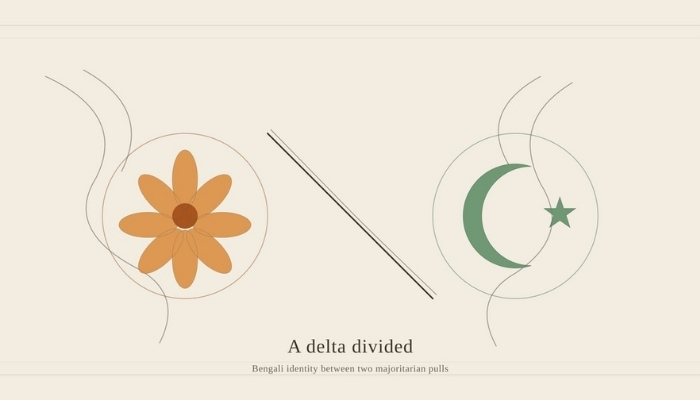

For nearly two centuries, “Bengali” has meant something more than a passport or a province. It has meant a civilizational claim — that a Hindu zamindar’s son reading Tagore in Santiniketan and a Muslim weaver’s daughter reciting Nazrul in Mymensingh belonged to the same imaginative world, regardless of which god they prayed to. That claim survived the horrors of Partition, survived the Liberation War of 1971 fought explicitly against the idea that religion alone could define a nation, and survived decades of often-corrupt, often-authoritarian governments on both sides of the border who nonetheless paid lip service to it. In 2026, for the first time since 1947, that claim is being squeezed from both directions at once — and the space in the middle, where a liberal, secular, religiously plural Bengali public life used to live, is shrinking faster than at any point in living memory.
The View From Kolkata, Agartala and Guwahati
In May, the Bharatiya Janata Party won West Bengal for the first time in the state’s history, ending fifteen years of Trinamool Congress rule and breaking what was, until this year, one of the last major holdouts against Hindutva politics in eastern India. It did so on a platform that fused its national Hindu-nationalist program — a Uniform Civil Code, a law on religious processions framed as redress against alleged anti-Hindu bias, accelerated citizenship for non-Muslim migrants under the Citizenship Amendment Act — with an unprecedented effort to claim Bengali cultural symbols for itself, invoking Tagore, Chaitanya Mahaprabhu and regional festivals in its campaign materials. The fusion worked. More than nine million voters were struck from the rolls in a contested “Special Intensive Revision” beforehand, falling disproportionately, according to on-the-ground reporting, on poor Muslim and migrant-worker communities along the Bangladesh border. Weeks after taking office, the new chief minister, Suvendu Adhikari, launched a “detect, delete and deport” campaign against undocumented migrants — explicitly exempting Hindus and other non-Muslims under the CAA, and indicating that those detained might not be guaranteed a court hearing before deportation.
This was not an isolated event. It was the culmination of a pattern already entrenched next door. In Assam, the BJP government of Himanta Biswa Sarma has, since 2021, demolished more than 22,000 structures and deported over a thousand people, often through a Foreigners Tribunal system that rights groups call arbitrary, frequently targeting Bengali-speaking Muslims whose families have lived in India for generations. The United Nations’ own Committee on the Elimination of Racial Discrimination wrote to Delhi in January formally raising concerns about discriminatory evictions and hate speech against this community. In Tripura, the BJP has governed since 2018 by consolidating the state’s Bengali Hindu majority — many of them descendants of refugees from East Pakistan and Bangladesh — against the state’s tribal population, a dynamic that has normalized treating “Bengali” and “Hindu” as functionally interchangeable categories in a way the older, language-first conception of Bengali identity explicitly rejected. Taken together, three of the four major Bengali-and Bengali-adjacent polities under Indian sovereignty are now governed by a party whose foundational ideology holds that India is, at root, a Hindu nation — a premise that the secular, syncretic strand of Bengali nationalism was built to resist.
The View From Dhaka
Meanwhile, across the border, the political space vacated by Sheikh Hasina’s ouster in 2024 has not been filled by the secular student movement that toppled her. The Bangladesh Nationalist Party, which won the February 2026 election decisively, markets itself as centrist and has notably fielded and promoted Hindu and indigenous lawmakers. But it governs in the shadow of Bangladesh Jamaat-e-Islami, the country’s largest Islamist party, which posted its best electoral result ever — 68 seats and roughly 32 percent of the vote — and now controls the parliamentary opposition. The balance of power this creates is precarious for anyone hoping the post-Hasina transition would entrench secular governance. Analysts at the East Asia Forum have documented how this pressure already shapes policy at the level of national symbolism: this spring’s dispute over Bangladesh’s UNESCO-listed Bengali New Year procession, the Mangal Shobhajatra — long a touchstone of secular Bengali cultural nationalism, renamed during the interim period and then given a deliberately neutral name after objections from Islamist groups like Hefazat-e-Islam — illustrates how even symbolic, non-legislative concessions are accumulating. The same analysis describes Bangladesh’s political competition as increasingly confined to a conservative spectrum rather than a left–right one, with the BNP itself courting conservative religious scholars through new Iftar and zakat-focused outreach that would have been unthinkable for a secular-nationalist Awami League government.
Hindus, who made up over a fifth of Bangladesh’s population at Partition, are now roughly 8 percent and falling — about 13 million people in a country of 170 million — a demographic hollowing-out that long predates 2024 but has been compounded by the lawlessness of the 18-month interim period, during which targeted attacks on Hindu communities went largely unpunished. The BNP’s apparent good intentions on minority protection are themselves now hostage to Jamaat’s growing organizational strength: as Carnegie’s South Asia program has warned, any attempt by the ruling party to restrict its Islamist rival risks “catalyzing active political mobilization along conservative, Islamist lines” rather than containing it — meaning Dhaka’s government has limited room to actually govern as secular as it claims to want to.
A Pincer, Not Two Separate Stories
What makes this moment distinct from earlier periods of communal tension in Bengal is the simultaneity and the feedback loop. BJP campaigners in West Bengal explicitly invoked the post-Hasina treatment of Hindus in Bangladesh as evidence of an “Islamic threat” requiring a Hindu-nationalist response at home — whether or not those claims were precisely accurate mattered less than their political utility, as observers writing for Countercurrents have noted. In turn, the BJP’s landslide and the subsequent deportation drives in West Bengal have, according to East Asia Forum’s analysis, “likely heightened perceived risks in Dhaka over border enforcement, citizenship verification and possible ‘queue-jumping'” — feeding precisely the nationalist, anti-India sentiment that benefits Jamaat-e-Islami and hardline elements within the BNP. Each side’s majoritarian turn provides the other side’s majoritarians with their best argument. A Bengali Hindu family that fled communal violence in East Pakistan in 1971 and a Bengali Muslim family facing a Foreigners Tribunal notice in Assam today are, in a grim sense, victims of the same underlying failure: the collapse of a shared political vocabulary that once let Bengali identity function as a counterweight to, rather than a vehicle for, religious nationalism.
What Is Actually at Stake
For the people this affects most directly — independent journalists, secular cultural organizers, interfaith families, ordinary migrant workers without perfect paperwork, religious minorities on both sides of the border — the practical consequence is a narrowing of safe political ground. The institutions that historically absorbed and moderated communal tension are themselves compromised or gone: the Awami League, whatever its authoritarian sins, is banned in Bangladesh; the Trinamool Congress, whatever its own clientelism, has lost power in West Bengal for the first time in fifteen years. What remains in both capitals are governments whose electoral coalitions depend, to varying but rising degrees, on treating religious identity as a primary organizing principle of political life — a 2,500-mile border’s worth of communities for whom the answer to “who is a real Bengali” is increasingly being decided not by language, literature or shared history, but by which side of a citizenship test, a voter roll revision, or a parliamentary alliance they happen to fall on.This piece reflects the analytical framing requested; readers should note that BJP, BNP and Jamaat-e-Islami officials each dispute characterizations of their parties as threats to pluralism, and that election results in both countries — the BJP’s record turnout in West Bengal, and the BNP’s decisive win over Jamaat in Bangladesh — are themselves cited by supporters as evidence that voters do not share this assessment of their own choices.